Never Dumb: Use Your Pomodoro Breaks to Stay Sharp
Turn Pomodoro breaks into cognitive training instead of doomscrolling, with 13 exercises across three modes built into Pomodorian's Never Dumb feature.
Pomodorian is a free, AI-powered Pomodoro timer. No account required.
Try the timer→What you do during your break decides what AI does to your brain. Not what you do during the work block, the break. If you spend your 25 minutes of focus reasoning carefully and then spend your 5-minute break letting a feed pour novelty into your skull, you've just cancelled out the training effect of the work you did.
Doomscrolling isn't a pause. It's a change of input stream. Your brain doesn't get quieter, it gets fed something else, something optimized to keep grabbing your attention rather than let it go. That's the opposite of what a break is supposed to do.
I built a feature into Pomodorian called Never Dumb specifically to fix this. Here's the thinking behind it, the science it's built on, and the 13 exercises that make it up.
Why active breaks beat the feed
Breaks work because unbroken focus decays fast. A 2011 University of Illinois study, covered in a university press release, had participants work on a 50-minute computer task. The group that took two brief diversions kept their performance steady. The group that didn't got measurably worse over the same period, even though nobody decided to stop trying. This is the vigilance decrement: your brain quietly downgrades a goal's importance the longer it stares at it, and a short break resets the signal.
A 2022 meta-analysis in PLOS ONE, reviewing 22 studies and over 2,300 participants, found that micro-breaks under 10 minutes reliably preserve vigor and reduce fatigue. The break doesn't have to be long. It has to be the right kind.
The right kind, according to the evidence, is one that changes what your attention is doing rather than just changes what it's looking at. A Stanford study by Oppezzo and Schwartz found that 81% of participants generated more creative ideas while walking than while sitting, and the effect outlasted the walk itself. Scrolling a feed does the opposite: it keeps your brain in the same stimulated, information-processing mode as the work you just left, wearing the costume of rest. For more on what actually restores focus during a break, use your breaks effectively and micro-breaks go deeper into the research.
Never Dumb takes that principle and points it at a newer problem: what happens to your reasoning when an AI tool does most of your thinking for you, all day, every day.
The philosophy: the AI can finish the sentence, not the thought
Here's the line Never Dumb is built around: the AI can finish the sentence. It must not finish the thought.
Using AI tools well during focused work is fine. The risk isn't the tool, it's what happens in the gaps around it. If every idle moment, including your breaks, gets filled with more AI output, you never practice holding a thought yourself. You get faster at prompting and slower at reasoning, quietly building cognitive debt: a gap between what you can still do unassisted and what you've handed off. The skill that atrophies is the one you'd need most when the tool is wrong, unavailable, or simply not the point.
I've noticed this in my own life outside of work too. My biggest ideas don't show up while I'm looking at a screen. They show up in the shower, on a walk, in the pool, in the dead time I used to fill with a phone. I deleted the AI apps from my phone for exactly this reason: to protect those dead times, because that's where the actual thinking happens, not the typing.
Never Dumb brings that same protection into your Pomodoro breaks. It's not about banning AI. It's about making sure a few minutes of every break belong entirely to you, no completion, no suggestion, no autopilot, a small, regular claim on your own cognitive sovereignty. That's what "never dump your brain" means: don't hand off the part of the thinking that's yours to keep.
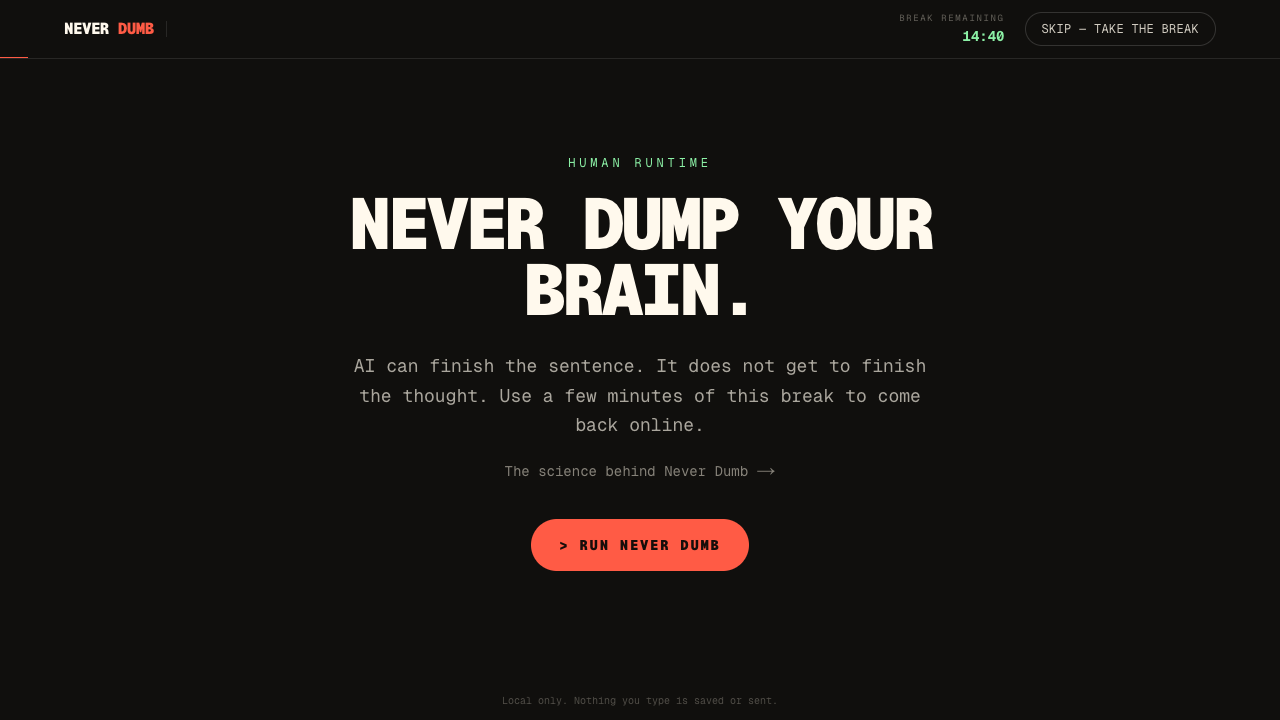
For a full walkthrough of every screen and setting, see How to Use Never Dumb in Pomodorian.
The 13 exercises, by mode
When Never Dumb opens, you choose what you need: Serious, Fun, or Reset. Each mode does a different job.
Serious: rebuild the reasoning
Serious mode is friction on purpose. The point is to do the mental work before you get to see the answer.
- Rebuild asks you to reconstruct, without reopening the AI chat, the three decisions you made in your last focus block, naming each decision, the reason behind it, and what would make you reverse it. If you can rebuild the reasoning, the answer is still yours.
- Break the Answer hands you a function that claims to return active users and asks you to find the logic error before reading the reveal, then explain the failure in one precise sentence. It's a small, deliberate bug hunt: the code maps every user to a boolean instead of filtering the inactive ones out.
- Compress takes a source and asks you to compress it into one invariant and one open question, using no more than 25 words total. A useful summary keeps the constraint and the uncertainty. It doesn't just smooth out the prose.
All three exist to reconstruct reasoning, catch a flaw, or compress noise, exactly the kind of reasoning muscle that gets soft when an AI tool always finishes the thought for you.
Fun: move your body, prove you're human
Fun mode trades depth for movement and a bit of absurdity. You get one of four surprise games.
- Human CAPTCHA gives you a slightly ridiculous physical mission, no camera, no microphone, no score, purely an honor system. A model could describe the mission. It couldn't enjoy how stupid it felt to do it.
- Room Raid sends you away from the desk to find three specific things, no photos allowed, then asks you to recall them without looking again once you're back.
- Body Debugger has you follow a string of physical commands except any prefixed with "AI SAYS", a small test of movement plus inhibition. If you obey the AI command anyway, the metaphor writes itself.
- Rubber Duck Boss asks you to answer questions out loud before you can "hit" the boss, typing optional. The duck wants clarity, not tokens: you explain it yourself before asking a machine to explain it for you.
These are lower-impact than Serious mode by design. What they're actually training is movement and a kind of proof of aliveness: physical, improvised, unscriptable.
Reset: breathing, meditation, walking
Reset mode is the quiet option, for when what you need isn't a puzzle but a genuine downshift.
- Breathing 5-5 paces you through five seconds in, five seconds out, for three minutes.
- Open Meditation gives you sparse prompts to notice sounds, sensations, and thoughts without trying to fix them, three minutes with no performance target.
- Body Scan moves your attention through each part of your body without trying to change anything, three minutes to soften what can soften.
- Five-minute Walk sends you away from the screen entirely, no phone, no podcast, no productivity objective.
- One-track Reset plays three minutes of a local lofi track and asks you to do nothing else while it plays.
- Invisible Ping Pong has you stand and mime returning a ball left to right for sixty seconds, a quick way to cross the midline and prove you're still a mobile mammal.
Six options because context varies: some days you can step outside, some days you're in an open office and a body scan is the only realistic reset. The point of every one of them is the same: leave the feed, don't fill the pause with more input.
How to turn it on
Never Dumb opens automatically at your long break, the one that follows your fourth pomodoro. You don't have to do anything for it to show up. If you'd rather trigger it manually or skip the auto-open entirely, there's a toggle in Settings called "Auto-open Never Dumb on long breaks."
Worth being honest about where this feature stands: it's young. I built the first version of the exercises and modes based on the philosophy above, but I haven't tuned it against months of real usage yet. If a prompt falls flat, an exercise feels off, or you have an idea for a better one, the in-app feedback form goes straight to me. That feedback is genuinely how this gets better.
Key Takeaways
- Doomscrolling during a break isn't rest, it's a change of input stream that keeps your brain in the same stimulated, information-processing mode as work.
- Active, attention-switching breaks have measurable backing: Illinois found brief diversions prevent the vigilance decrement, and Stanford found walking boosts creative output by 81%.
- Never Dumb's philosophy is simple: the AI can finish the sentence, it must not finish the thought. Breaks are where you practice reasoning without the tool finishing it for you.
- The 13 exercises split into three jobs: Serious rebuilds reasoning through friction, Fun adds movement and a proof of humanity, Reset gives you a genuine physiological downshift.
- Never Dumb auto-opens at your long break (after your 4th pomodoro) and can be toggled off in Settings if you'd rather trigger it manually.
Frequently Asked Questions
What is Never Dumb in Pomodorian?
Never Dumb is a break feature in Pomodorian that offers 13 short exercises across three modes, Serious, Fun, and Reset, so your Pomodoro breaks build cognitive resilience instead of defaulting to a phone feed.
When does Never Dumb open?
It opens automatically during your long break, the one that follows every fourth pomodoro. You can turn off the auto-open in Settings and launch it manually instead if you prefer to choose when it appears.
Does Never Dumb save or send anything I type?
No. Everything you type during an exercise stays local to your device. Nothing is saved or sent anywhere, the same no-database approach Pomodorian uses for all of your other data.
Why not just scroll during a break instead?
Scrolling keeps your brain in the same stimulated, information-processing mode as focused work, so it doesn't give you the type of attention switch that actual recovery requires. Never Dumb's exercises are built to switch modes on purpose, through reasoning, movement, or a genuine physiological reset.
Is Never Dumb finished, or still being improved?
It's an early feature. The 13 exercises reflect a first pass at the philosophy, not a final, fully tuned set. Feedback submitted through the in-app form directly shapes what gets added or changed next.
Sources
Ready to focus smarter?
Try Pomodorian, the AI-powered Pomodoro timer. Free, no account required.
Start Focusing